LYMEPOLICYWONK: RELATIVE WEIGHT–Specialty Societies vs Patients, AKA no contest

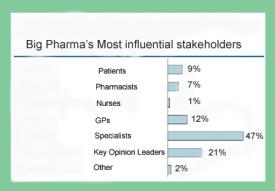
There are four primary players in health care today: big Pharma, insurance, patients, and physicians.  Key opinion leaders and medical specialty societies are seen as third party marketers for pharma, and pharma provides ample funding to both—which is partially why Grassley is investigating medical societies in general.

That is how big Pharma sees the state of play.  What about insurers?  Whose side are they on?  It’s pretty much a given that they are not on the side of patients—at least not on the side of Lyme patients.  They are on the side of cost control and the IDSA gives them guidelines for Lyme that amply suit that purpose.  So back to the question.  Specialty Societies vs Patients? Guess it’s no contest.

Note and caveat:  The slide is from a presentation given by Johnson & Johnson at an eyeforpharma conference in 2008.  The information is a survey in Europe, but I would be surprised if the US differed on this.

You can contact Lorraine Johnson, JD, MBA at lbjohnson@lymedisease.org.

Similar Posts

  • Silencing the sick– IDSA wages calendar warfare

    How is it possible for the IDSA to have a public guidelines review on Lyme Disease hearing date set for April 27th when it hasn’t notified speakers that they will be speaking at the hearing? When it hasn’t even selected speakers? When it hasn’t even posted applications for speakers on its website? When it hasn’t reserved a room for the event? You’d think this group had never held a conference before—but wait— it holds annual conferences! So this organization KNOWS how to prepare for and hold a big event that will have a number of speakers; it knows how to reserve a room; and even how to select speakers and give them time to prepare. In fact, it has already worked out all of these details for its own annual meeting in October, which is more than 6 months away. They have a list of speakers, the assigned topics and reserved facilities— the whole nine yards.

  • Lyme Policy Wonk: Fresh back from the conferences!

    Fresh back from the Columbia/LDA conference and the ILADS conference in Washington, DC. I love going back for these conferences because I see all the people I have talked to over the year and so rarely lay eyes on. I love the energy of the conference. This year, the ILADS conference had break-out sessions on evidence-based medicine and research. These were working groups with a lot of discussion generated—the type of discussion that only occurs when people are together in the same room and real time conversation occurs sparked by ideas. This was energizing to me.

  • LYMEPOLICYWONK: CDC Tells Poughkeepsie Journal Long Term Antibiotics Not Warranted; I Respond

    Dr. Lyle Petersen of the CDC wrote an editorial for the Poughkeepsie Journal in response to the remarkable series of articles by Mary Beth Pfeiffer on Lyme Disease. In his letter, Dr. Petersen restates the IDSA/CDC perspective patients have long heard. Lyme disease is easy to diagnose and treat, but for those with chronic Lyme treatment is both ineffective and dangerous. He proposed that we work on preventing Lyme disease and early diagnosis and treatment—both laudable goals, but not at the expense of treating seriously ill patients. My response to his letter, which I posted on the Poughkeepsie website (and encourage you to respond there as well) follows.

  • IDSA Lyme Double Speak

    Have you ever noticed how the IDSA says one thing, but really means and does another? For instance, how they say that their guidelines are there to protect patients when in fact they amount to medical abandonment? They are so stringent that sick patients are left completely without treatment options? Or how they say they are all about scientific evidence when in fact their guidelines are based primarily on expert opinion–the expert opinion of researchers with commercial ties to vaccine manufacturers, Lyme tests, and insurers? Or how they say their guidelines are not mandatory, but their members enforce their guidelines by testifying at unprofessional conduct hearings and the IDSA opposes physician protection legislation that would essentially make compliance with their guidelines truly voluntary? Or how they say they are worried about doctors who treat chronic Lyme making money off of sick patients, but they are not concerned about conflict of interest on their guidelines panels? This is called double speak. Saying one thing, doing another. George Orwell described this type of practice "newspeak"–words "deliberately constructed for political purposes: words, that is to say, which not only had in every case a political implication, but were intended to impose a desirable mental attitude upon the person using them." I'd say we could all use a little more plain talk.

  • LYMEPOLICYWONK: ILADS Weighs in on IOM Process

    Today, ILADS sent a letter to the IOM expressing its concerns about the lack of balance in the panel and the speaker list for the Lyme State of the Science conference. Not surprisingly, it was concerned primarily about the exclusion of ILADS physicians from presenting at the conference and with the large roles handed to Dr. Wormer, chair of the IDSA Lyme guidelines panel, and Dr. Aguera-Rosenfeld, who until recently worked at NYMC with him, are both known to have biased views regarding the diagnosis and treatment of Lyme disease. Exclusionary conduct on the part of the IDSA has prevented the type of scientific debate that is essential to understanding where the science in Lyme disease rests. ILADS took issue with the large roles handed to the IDSA in the diagnosis and treatment issues at the conference, stating: “There is a significant disconnect between IDSA and the community of physicians who treat Lyme disease. There is also an urgent need for transparency in recognizing the limitations of the existing Lyme research. The bulk of the research on Lyme treatment has been controlled by IDSA researchers. Their research is based on sample populations that do not reflect those seen in clinical practice.” Lyme treatment research has been plagued by sample sizes that are too small to measure clinically relevant treatment effects and that do not reflect the types of patients seen in clinical practice. The link to the ILADS letter follows the jump. . .

  • IDSA Lyme Disease Review Panel Announces Public Input Period and Hearing Date

    The IDSA review panel has announced that the period for the public to submit information to ensure that all points views are taken into consideration is open. Submissions must be received by April 3 and should not exceed 5 pages. The public hearing date has been set as April 27th in Washington DC area. Information on how to apply to be a presenter will be forthcoming.