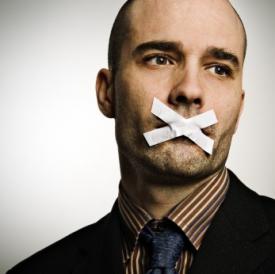
JAMA to conflict of interest breaches—silence is golden

The problem with relying on medical journals like JAMA to police failures to disclose conflicts of interest of authors is that  the  journal has a reputational dog in the hunt so to speak—a point which JAMA makes in explaining that disclosures of these conflicts by others “potentially damages our ability to complete a fair and thorough investigation … [and]  potentially damages JAMA’s reputation by the insinuation that we would fail to  (investigate).”  A case in point is Gostin’s recent JAMA article on the IDSA Attorney General investigation into antitrust violations by the Infectious Diseases Society of America (IDSA) in the development of guidelines for the treatment of Lyme disease. Gostin’s article was a polemic piece that assumed two things: first, that the IDSA was “right” on the science of Lyme disease, and second, that antitrust law could not apply to the case.  This is not just “assuming a lot;” it is “assuming everything.”  Predicating an argument on broad stroke assumptions like these without critical examination of them should have no place in responsible journalism.

This article, written by two attorneys, did not refer to the law review articles analyzing the applicability of antitrust law to the case.  Moreover, in law (unlike medicine?!), the failure to cite an opposing viewpoint or case is considered an ethical breach (in a brief before a judge there might actually be sanctions for this type of trying to “run one past” the court).

The Gostin article did not, in short, smack of good journalism.  JAMA knew the issue was hotly debated (I had sent in a letter to the editor on the Sniderman article calling for guidelines reform).  But the journal elected not to run both sides of a hotly contested issue, and it seems highly doubtful that the article would have passed peer review in its published form.

More letters to JAMA, one submitted for publication regarding the Gostin article (summarily rejected), and the other to their editor (not for publication) but pointing out that the Gostin article looked like an IDSA “plant” with no peer review and noting that the article was written by the editor of the health and ethics section of JAMA.  Hence, he selected and published and controlled the editing of his article?  No response again.  Back of the hand.

I do not think the editors of medical journals are “above the fray.”  They are part of the problem.  And, JAMA’s new policy merely underscores the type of high-handedness that is giving medicine a bad name.

Similar Posts

  • LYMEPOLICYWONK: IOM Report: ’Tis neither here nor there. Or?

    The Institute of Medicine (IOM) has released its long awaited report on Lyme disease. So should we celebrate or despair? I think there is room for a little of both. We should certainly celebrate the tone of the report, which characterizes the session as “a walk in the woods” to start dialogue and we should celebrate the contributions made by those who attended and participated, whether as patients, advocacy groups, researchers or physicians. I think these people did their very best to represent a side of Lyme disease that is not often given public voice. We should also recognize the contribution to a better process that was achieved by the three groups who pulled out of the hearing (CALDA, LDA, and Time for Lyme). This action resulted in Dr. Benjamin Luft of Stony Brook University being added to the agenda and may have also added to the “tone” of the report. What we should not lose sight of though, is that a civil tone and the inclusion of some patients’ testimony are not enough. This is a debate about science. Debates are about equal time, opportunities to rebut, and not excluding opposing viewpoints. That did not happen here. And, what the IOM left out or left unchallenged harms patients. Our biggest hits were in diagnosis, the exclusion of the topics chronic Lyme and treatment, and the complete exclusion of any physicians from ILADS. Let me drill down into the details.

  • Lyme disease: Losing your innocence in science

    Having Lyme means losing your innocence, utterly, in science. It's true. I am remembering the night I explained evidence-based medicine to a friend whose daughter had Lyme. I explained that in Lyme evidence-based medicine was a “tool” for persuasion in a polemic argument. He was stunned. His daughter had Lyme. He believed in science. He had trouble, real trouble, getting his daughter diagnosed and treated. He knew the problems of Lyme from the inside out. But it hadn’t occurred to him that science wasn’t “pure” science. That researchers followed their bias, their pet theories, their commercial interests in designing and interpreting studies. It was an interesting moment with this sharp and concerned father while he tried to understand the depth of the problem in Lyme. It was a moment when innocence is utterly lost for the first time to those who know how the system of science “ought” to work.

  • LYMEPOLICYWONK: Recognizing the problem is the first step—Persistence.

    An important study by Dr. Stephen Barthold and Dr. Ben Luft was recently published. The title sounds a bit bleak, but don’t let the title fool you: “Ineffectiveness of Tigecycline against Persistent Borrelia burgdorferi”. This study is about how the little guy (Borrelia burgdorferi) always wins and survives despite antibiotic treatment—here tigecycline. To my mind, the findings on persistence are much more important than the finding that tigecycline doesn’t do the job. When one antibiotic doesn’t work, you try another, and if that one doesn’t work, well, you try another or you kick it up a notch and start trying combination antibiotics, like they do with tuberculosis. You don’t fold up the tent and go home because active infection requires antibiotic treatment. And, you won’t ever find out which antibiotic or combinations of antibiotic work, until you try them. So, roll up your sleeves, we have some work to do here.

  • Ground Zero Lyme Disease: Check out Pollack’s AG article

    If you haven't read the article by attorneys Elliott Pollack and Christine Collyer in the Connecticut Law Tribune, "Attorney general
    challenges controversial Lyme disease guidelines", I suggest you check it out. Those familiar with the Jones case in Connecticut will recognize their names. Early on in the case, I had the pleasure of working with these attorneys and have appreciated the high level of competency and professionalism as well as their dogged pursuit of justice for Dr. Jones. Connecticut is ground zero for Lyme disease–with the Jones case, the Connecticut Attorney General antitrust investigation against IDSA, and the pending state legislation that would provide protection for treating physicians.

  • LYMEPOLICYWONK: Embers Monkey Study Part 3. IDSA 28 Day Treatment Protocol Fails to Clear Infection.

    This is Part 3 of a series on the Embers study of Lyme disease in non-human primates. As described in Part 1 of the series, the Embers monkey research study posed three questions: one regarding treatment of early disseminated Lyme disease, one regarding treatment of late disseminated Lyme disease, and one regarding the ability of the C6 to accurately detect infection. This part focuses on the first question–the ability of 28 days of antibiotics to eradicate infection in early disseminated Lyme disease. The 28 day treatment with doxycycline was intended to test the treatment recommendation of the Infectious Diseases Society of America (IDSA). The Embers study found that infection persisted in all monkeys treated with this protocol.