LYMEPOLICYWONK: IDSA Guidelines Survey

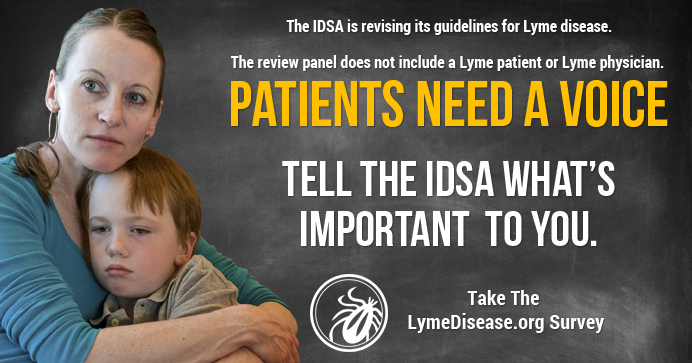
We will present these in our formal comment submission to the IDSA on April 9th and to help promote patient interests in Lyme disease legislation and healthcare policymaking. Today patients struggle for access to the care needed to be well again.  The Institute of Medicine requires that those affect be involved in the process. Yet, the IDSA has excluded chronic Lyme patients from its panel.  Instead, they have selected a patient who does not have Lyme, has no knowledge of Lyme–someone who is not known to the Lyme community and who is not empowered by this community to represent our interests.

Our last survey on proposed FDA regulations of Lyme disease tests drew over 8,000 responses within a few months.  We expect to draw thousands for this survey by April 9th when we submit our formal contents and continue collecting responses even beyond that date to provide some real information on what patients think is important in Lyme diagnosis and treatment.  Raise your voice with ours–and let’s be heard as a community! Take the IDSA Survey Now. The LYME POLICY WONK blog is written by Lorraine Johnson, JD, MBA, who is the Chief Executive Officer of LymeDisease.org.You can contact her at lbjohnson@lymedisease.org. On Twitter, follow her @lymepolicywonk

Similar Posts

  • LYMEPOLICYWONK: The IDSA chooses a token patient for its new guidelines revision process

    For the past 11 years, the IDSA has refused to include patients (as well as researchers and physicians who are not like-minded) on its Lyme guidelines panels. The group has also fought against patient representation on federal and state advisory boards. On March 9th, they announced a new guideline development process. This time, they have included a patient representative. Why the sudden change? And, more to the point, should patients rejoice or weep?

  • IDSA announces presenters and order of presentation

    The Infectious Diseases Society of America has selected presenters to speak before its Lyme disease guidelines review panel on July 30. (This is part of the guidelines review process mandated by the IDSA’s settlement with the Attorney General of Connecticut.) The speakers representing patient advocates are Tina Garcia, of the Lyme Education and Awareness Program (LEAP) and me. Three researchers that are not affiliated with either ILADS or IDSA will speak: Drs. Brian Fallon from Columbia, Ben Luft from Stony Brook, and David Volkman, previously from the National Institute of Health (NIH). The following members of ILADS will be presenting: Drs. Daniel Cameron, Ken Liegner, Steven Phillips and Raphael Stricker. In addition, Allison Delong, MS, of Brown University, and Dr. Donta, a member of IDSA, will present. Those advocating for the IDSA guidelines include Drs. Phillip Baker (President of the American Lyme Disease Foundation and previously with NIH), Barbara Johnson (Centers for Disease Control), Eugene Shapiro, Sunil Sood, Allen Steere, Art Weinstein and Gary Wormser.

  • Shifting sands of time–IDSA calendar revisions at hand

    The IDSA is expected to extend the time period for document submissions to the 24th of April. Jennifer Padberg expects to post a new calendar of events early next week, at which time she also expects the application process for presenters to be opened. The presentation date will likely be pushed until summer. Presenters will be selected by the IDSA, the ombudsman, and the Connecticut Attorney General. ILADS-affiliated speakers will be permitted an equal amount of time for presentations. I will post more news as it becomes available.

  • LYMEPOLICYWONK: Patient Centered Research and Lyme—An idea whose time has come?

    A friend forwarded to me the audio link (at the end of this blog) of an interview with Dr. Iain Chalmers of the Cochrane Collaboration—a leading voice in evidence based medicine. Dr. Chalmers, who is interested in the patient perspective in evidence-based medicine, made a number of points that I think you will find of interest. First, he said, research agendas should be driven by patient concerns rather than by researchers’ preferences. There’s an interesting idea. Then he said that physicians have to make a decision today and cannot wait for the research. That sounds right, too. He went on to say that when you are looking at outcomes, the clinical experiences of those who receive the intervention or treatment are the key—these experiences are not the soft data, they are, in fact, the “hard” evidence. Finally, he noted the difficulty of getting “disappointing” results published. Disappointing results can be trials that don’t turn out as planned or that contradict what the researcher expected. His last quote regarding academic researchers in particular stuck with me and should resonate with the Lyme community: “If you have a cherished hypothesis which your career has ridden on for the past 20 years and someone does a really killer experiment which actually shows that you have been wrong all that time, the natural reaction, the human reaction is to say “there must be something wrong with it”—“I can’t have been wrong all these years”. It all sort of takes me back to the Embers monkey study and the complaints of Dr. Baker’s (formerly of the NIH and now the head of the American Lyme Disease Foundation, which many patients believe is a front for the Infectious Diseases Society of America).

  • IDSA Hearing–Reflections

    The IDSA Lyme disease guidelines review hearing on Thursday was an historic event both in medicine and in the Lyme community. It is the first time an organization has been required to hold hearings and review treatment guidelines that were created by a panel with conflicts of interest. It is also the first time that a broad debate of both sides of the Lyme controversy over diagnosis and treatment with physicians and researchers has been held.

  • |

    LYMEPOLICYWONK: Students at risk for Lyme: Will lawsuits make a difference?

    Two new Lyme cases should make school and summer camp officials more vigilant about preventing tick-borne illnesses in students. The fact is that the threat of a law suit can motivate needed change. I remember how difficult it was to get schools to take rape seriously. For years, people complained and nothing happened. Then lawsuits were filed and campuses woke up. They started educating students about rape risks and precautions, installing more lights, making guards available to walk students to their cars late at night and so forth. Parents and students would welcome that type of sea-change in Lyme disease prevention.