LYMEPOLICYWONK: Study Finds Coinfections in Lyme Disease Common

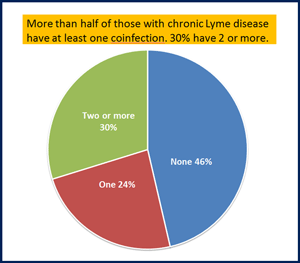
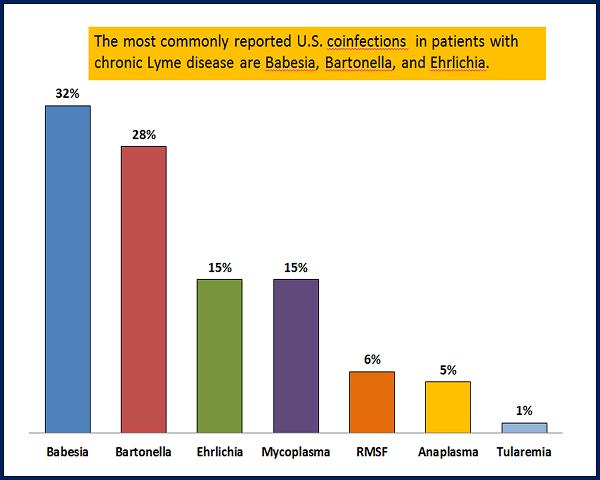
It turns out that coinfections are the norm.  Laboratory confirmed co-infections were  reported by 53% of respondents and 30% reported two or more co-infections.  Similar results were found in a study of 106 patients by Dr. Janet Sperling and colleagues in Canada, with 50% reporting laboratory confirmed coinfections and 36% reporting two or more.

The most common in our study were Babesia (32%), Bartonella (28%), and Ehrlichia (15%).
In Sperling’s the most common coinfections were Bartonella (36%) and Babesia (19%), followed by Anaplasma (13%). The difference in which infections are most prevalent may reflect geographical factors given that Sperling’s study involved primarily Canadian patients with Lyme disease. (Note: Although ticks and humans are known to be infected with Bartonella, the mechanism for transmission has not been resolved.)

This study makes it clear that co-infections are common in those with chronic Lyme. We don’t know the rate of co-infections among those with early Lyme disease.  It may be that patients with early Lyme disease have lower rates of co-infections.  If so, may help explain why those with chronic Lyme are so sick.

The study was a joint effort of LymeDisease.Org and Prof. Jennifer Mankoff at Carnegie Mellon University. 

The LYME POLICY WONK blog is written by Lorraine Johnson, JD, MBA, who is the Executive Director of LymeDisease.org. Contact her at lbjohnson@lymedisease.org. On Twitter, follow me @lymepolicywonk.

RESOURCES:

Johnson, L., Wilcox, S., Mankoff, J. and Stricker, RB (2014) Severity of Chronic Lyme Disease Compared to Other Chronic Conditions: A Quality of Life Survey. PeerJ, DOI 10.7717/peerj.322. (Open access.)

The press release for the survey is here.

The Sperling study is also available open access.

This blog is the second in a series of blogs on the Quality of Life Survey. (Stay posted!) Other blogs in the series include:

Survey Results Published! Chronic Lyme Patients Suffer Poor Quality of Life and High Rates of Disability and Unemployment


Similar Posts

  • LYMEPOLICYWONK: Expired Drugs—Are they Effective, Safe?

    This is a little off topic for my blog, but something that is of high interest to patients. Patients ask all the time about the effectiveness and safety of “expired” drugs. A recent article that appeared in the Medical Letter examines the issue in detail. The article notes that generally manufacture expiration dates merely reflect the fact that the drug is “stable” at that point, they do not reflect when the drug becomes unstable. The conclusion of the article indicates that outdated drugs may be effective and safe for at least 5 years after the expiration. Notable exceptions include liquid suspensions and epinephrine in Epipen, which are not stable over time. The article also notes the following: " There are no published reports of human toxicity due to ingestion, injection or topical application of current drug formulations after their expiration date. Renal tubular damage has been reported after use of degraded tetracycline in a formulation that is no longer available (REF 2)." Other sources contain warnings about expired doxycycline, which may (or may not) be based on this outdated tetracycline warning, but patients may want to check with their doctors when using expired doxycycline to be on the safe side.

  • Lyme Policy Wonk: Beam me up, Scotty. See you after the jump!

    Why do we do what we do? Sometimes we win, but there are many, many (too many) bumps in the road on the way to success. How do we keep our perspective in the face of an adversary that seems unrelenting—vested, no entrenched, in a medical dogma that leaves patients on the side of the road? A medical society that believes that the views of patients are really–(really?) not relevant to the question at hand? I, for one, want to walk the road of other diseases that have been abandoned and forsaken by the medical establishment. But my road (and those of other illnesses), leads to success. And success–is all about the journey. Touching lives one by one until our day in the sun.

  • LYMEPOLICYWONK: Spotlight on an IOM Speaker: Does the IOM Know the Difference Between Dogma and Science? Rumor Hassett They Don’t!

    The IOM has slotted Afton Hassett to speak about “Potential Bio-Marker Applications for Lyme Disease: Aligning Multiple Symptoms with Biological Measures”. You might think he was a microbiologist or, or, or ? Well, it turns out that she is a Psy.D. What is a Psy.D.? It is a newish graduate degree in psychology. It does not focus on research or statistics, it focuses on the “soft” side of psychology, generally therapy (which is not a bad thing, but why should it weigh in on biology?) What does a therapist have to say about biomarkers specifically and why was she chosen over say, someone who actually knows about biomarkers, like Dr. Ben Luft? I shudder to think that this is about the psycholigization of an illness—namely turning an illness caused by a bacteria into a psychiatric illness, as in “don’t worry, it’s all in your head”. Afton Hassett, Psy.D., hails from the Chronic Pain & Fatigue Research Center, Department of Anesthesiology at the University of Michigan Medical School. Her view in a nutshell? Is that patients are nuts. How refreshing. She publishes with Dr. Lenny Sigal, a highly vocal anti-chronic Lyme light seeker. How reassuring. Some of her quotes follow after the jump. . .

  • LYMEPOLICYWONK: Institute of Medicine Cuts on the Bias for IDSA

    Finally, the Institute of Medicine (IOM) came out with its agenda for their “State of the Science Hearing”after much hemming and hawing. Patient groups (including CALDA) who asked for transparency in the study process received a mere “no comment” response. Well, we never got transparency, and we only got the agenda after it was finalized and released to the public. So, here’s the score: its 3 for 3 in the ‘Final Inning’ in favor of the IDSA.

    Four of the 6 IOM panel members are IDSA members.

    10 of the 14 physician speakers were authors on the IDSA guidelines or the copycat guidelines issued by members of the IDSA panel or members of the IDSA.

    Zero ILADS physicians have been chosen to speak. Let me repeat: ZERO, zip, nada, not a single ILADS physician was chosen to speak!

    Dr. Gary Wormser, poster boy of the Connecticut IDSA antitrust investigation, is kicking off the game.

    Oh, there’s window dressing to be sure. A personalized tour of the Agenda after the great leap forward. . .

  • LYMEPOLICYWONK: Dr. Fallon Sets the Record Straight—Part 2. Differences Matter.

    When studies fail to take heterogeneity into account, researchers can leap to the wrong conclusion. In a recent open-access article, Dr. Fallon and colleagues describe the four NIH trials, the Krupp Stop-LD study, the Klempner seronegative study, the Klempner seropositive study, and Fallon neurologic study and make a key point. There are considerable differences between chronic Lyme patients (so-called patient heterogeneity) that need to be addressed in study design to improve what he calls the signal to noise ratio. If a study does not address heterogeneity, the results may simply reflect “garbage in, garbage out.”