
Optimizing Exclusion Criteria for Clinical Trials of Persistent Lyme Disease Using Real-World Data
Johnson, L., Shapiro, M., Needell, D., & Stricker, R. B. (2025). Optimizing Exclusion Criteria for Clinical Trials of Persistent Lyme Disease Using Real-World Data. Healthcare, 13(1), 20. https://doi.org/10.3390/healthcare13010020
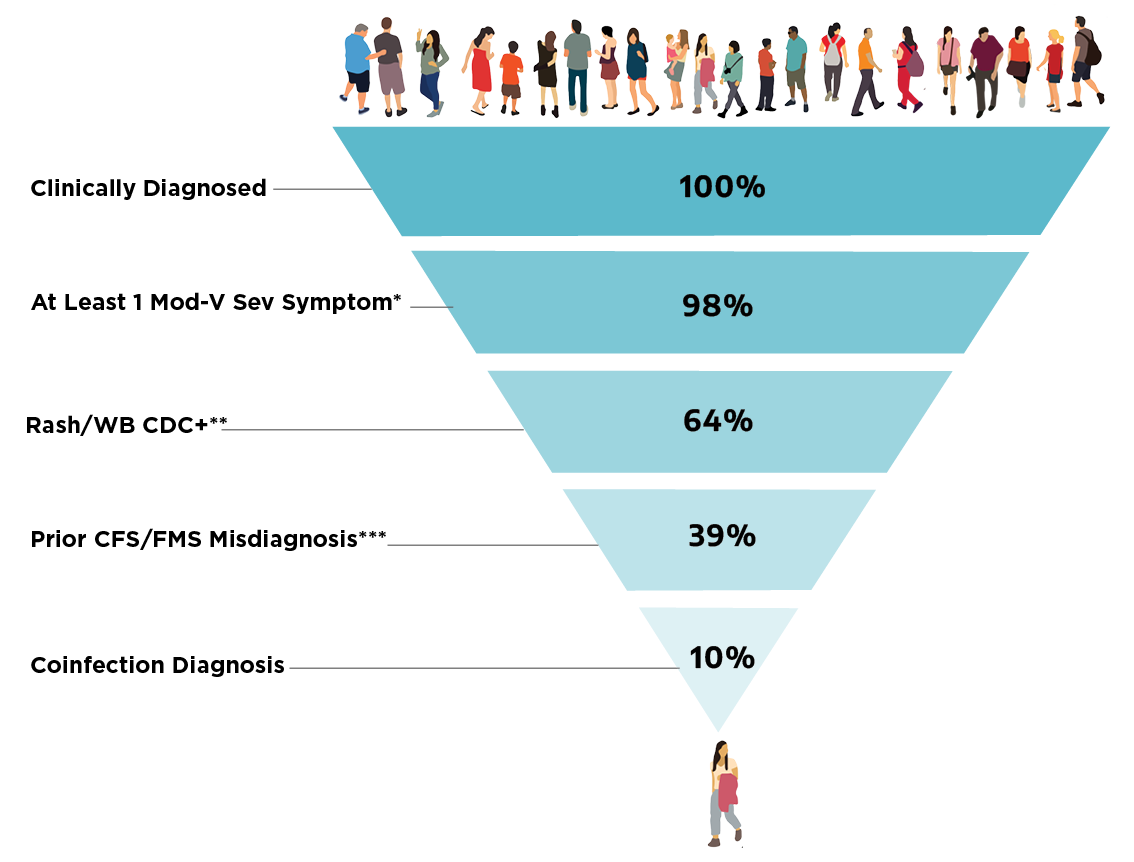
This study raises concerns that current Lyme disease clinical trials may exclude the very patients most affected by the illness. Using data from over 4,000 participants in MyLymeData, researchers compared individuals with persistent Lyme disease (PLD) to those with acute Lyme disease (ALD). They found that people with PLD experience substantially greater disease burden, including more severe symptoms, reduced quality of life, higher disability, and more frequent coinfections. For example, 74% of PLD patients reported being previously misdiagnosed—typically with chronic fatigue syndrome or fibromyalgia, compared to 43% of those with ALD.
When standard clinical trial exclusion criteria were applied—such as accepting only limited laboratory confirmation or excluding those with coinfections or prior misdiagnoses—approximately 90% of patients with PLD would have been ineligible to participate. Most importantly, the use of such stringent exclusion criteria has not been scientifically justified.
This suggests that many PLD trials are conducted on a small, unrepresentative subset of patients. As a result, study findings do not reflect the realities of those living with persistent illness or inform the care decisions clinicians must make every day. The study underscores the urgent need to reassess restrictive enrollment practices and adopt more inclusive criteria so that research better reflects PLD patients typically seen in clinical practice.
Background/Objectives. Clinical-trial eligibility criteria can delay recruitment, reduce sample sizes, and limit generalizability. Persistent Lyme disease presents additional challenges because symptoms and treatment responses vary and reliable biomarkers are lacking.
Methods and Results. Researchers analyzed data from 4,183 MyLymeData participants—3,589 with persistent Lyme disease and 594 with acute Lyme disease. Commonly used criteria would exclude approximately 90% of PLD patients. The analysis found that loosening restrictions involving coinfections and previous diagnoses of chronic fatigue syndrome, fibromyalgia, and psychiatric conditions could raise sample yield from 10% to 64%.
Conclusion. Real-world data can help researchers balance scientific justification with sample attrition and design trials that are more feasible, representative, and clinically useful.
Study Purpose
The study evaluates how commonly used clinical-trial eligibility criteria affect sample yield and whether the resulting research population represents patients with persistent Lyme disease seen in real-world practice.
Methods
Researchers analyzed responses from 4,183 MyLymeData participants and compared persistent and acute Lyme disease cohorts. They measured the individual and cumulative effects of commonly used eligibility criteria and examined the scientific rationale for those restrictions.
Key Results
Sequential application of common criteria reduced the eligible PLD sample to 10%. Excluding people with previous misdiagnoses and coinfections produced especially large losses because those experiences were common in the persistent Lyme disease cohort.
Recommendations
The authors recommend using scientifically essential criteria only, reporting the effect of each criterion on sample yield, and using real-world data during trial planning to improve recruitment, external validity, and clinical relevance.
The publisher’s article page contains the complete reference list, supplementary material, figures, and linked sources used in the study.
