LYME SCI: Helping your child avoid coronavirus AND Lyme disease
As if the coronavirus pandemic isn’t bad enough, we’re heading into peak tick season. With schools closed and kids running around their backyards, I wonder if folks are taking appropriate precautions.
Year after year, children have the highest number of tick bites. As most tick-borne illnesses begin with flu-like symptoms, I worry that many children will go undiagnosed—or misdiagnosed—this year.
The last thing anyone wants right now is a sick child. Even so, tens of thousands of US children will contract Lyme disease this year. And Lyme is only one of 16 reportable tick-borne diseases in the U.S.
As always, it’s best to prevent illness in the first place. You can help reduce tick bites by treating your yard and your pets, along with using tick repellent on you and your kids.
If your child gets sick, I hope that something I’ve learned will help you get through these tough times.
When my daughter was at her worst, we were either in the hospital, at a doctor’s office or having blood drawn (sometimes all three) in any given week.
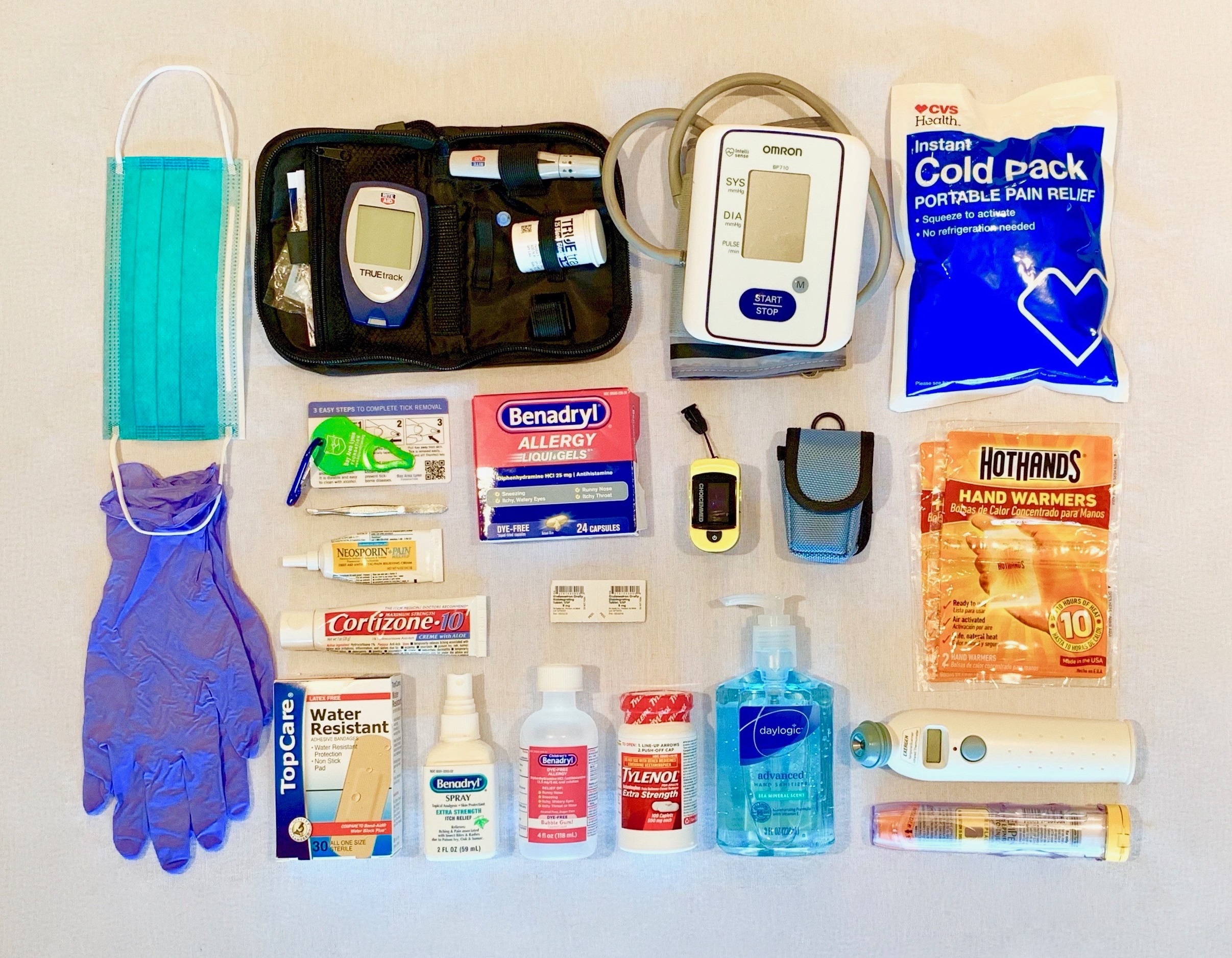
Over time, I put together a little “emergency kit” with all the things I frequently needed. I keep these in a small canvas bag so that I can easily grab it at night or take it along when traveling.
Plan ahead
First, do everything within your power to prevent tick bites. That means taking preventative measures for your pets, your yard, yourself and your family. Learn how to remove a tick and how to send it for identification.
When assessing a sick child, it’s important to remain calm. I recommend practicing with the items in your kit when things are good. This will also help you obtain a normal baseline (e.g. body temperature, blood pressure, blood sugar levels, if needed.)
For example, body temperature varies with time of day. Typically, our temperature is lowest between midnight and early morning, and highest in the late afternoon and early evening. The average body temperature is 98.6ºF. Your child’s temperature may average lower or higher than this, so it’s important to establish what is normal.
If your child gets sick
Call your doctor’s office. Give detailed symptoms of your child’s illness and ask their advice. Many offices will set you up with a video appointment with the doctor, or in some cases, instruct you to go to urgent care or the emergency room. Be ready to provide photos of any bites or rashes.
Train everyone in charge of your child’s care—including grandparents, babysitters, older siblings or anyone who will be left alone with your child—what the protocol is.
What’s in my kit
- Thermometer (measures body temperature)
- Blood pressure monitor (measures blood pressure)
- Glucose monitor (measures blood sugar)
- Pulse oximeter (measures blood oxygen level and heart rate)
- Dye-free Benadryl (for allergies or mast cell reactions)
- Anti-Itch and cortisone cream (for skin irritation or rashes)
- Tylenol (fever reducer)
- Tweezers and tick remover (because, well, you know me)
- Band-aids and Neosporin (for minor boo boos)
- Instant ice pack (headache, neck pain or applied to arm after blood draws)
- Instant hand warmers (for when we go to the freezing cold emergency room)
- Mask and gloves (protection if someone is infectious or immunocompromised)
- Hand sanitizer (before and after)
- Zofran for extreme nausea (requires prescription)
- EpiPen for anaphylactic allergic reactions (requires prescription)
Normal vital signs
- Body temperature decreases with child’s age (the AAP says a temperature above 100.4°F (38°C) is sign of a fever in children.)
- Blood pressure increases with age (eg. school-age child 95-112 (systolic) and 57-71(diastolic) vs. adult should run below 120:80. See full list here.)
- Heart rate decreases with child’s age (eg. an infant has 90 to180 beats per minute, vs. an adolescent with 50 to 100 BPM. See full list here.)
- Oxygen level. A normal pulse oximeter reading of your blood oxygen level is between 95% to 100% (runs lower when asleep). Anything below 90% is considered abnormal. If your child has a heart or lung condition, talk to your doctor about what is normal. (see the American Thoracic Society Pulse Oximetry handout here)
- Blood sugar will vary with age and meals. Pre-meal blood glucose is usually 80-130 mg/dL and around 180 mg/dL at 1-2 hours after eating. (See the American Diabetes Association for information on checking blood glucose)
When to go to ER
According to the American Academy of Pediatrics (AAP) your child may show any of the following symptoms during a life-threatening emergency:
- Strange or more withdrawn and less alert behavior
- Unconsciousness or no response when you talk with your child
- Rhythmic jerking (a seizure)
- Increasing effort or trouble with breathing
- Skin or lips that look blue, purple, or gray
- Neck stiffness with fever
- Increasing or severe persistent pain
- A cut that is large, deep, or to the head, chest, or abdomen
- Bleeding that does not stop after applying pressure for 5 minutes
- A burn that is large or involves the hands, feet, groin, chest, or face
- Any loss of consciousness, ongoing or worsening confusion, headache, or vomiting after a head injury
The AAP states, “In a serious emergency, you should always go to the closest ER—period.”
Other tricks up my sleeve
- Epsom salt foot soak or bath for achy muscles
- Honey in warm water for scratchy throat.
- Chicken soup loosens sinuses and is good for the soul.
- Chamomile or ginger tea for nausea.
- Steamy shower loosens phlegm and helps to clear lungs.
- BRAT diet (bananas, rice, applesauce & toast) for diarrhea.
- Pedialyte, electrolyte-replacement to help prevent dehydration.
- Wireless EKG for Smartphone
Make the best of the good times
Because having a sick child can be very stressful, it is important to find simple things to make you both happy. Watching a funny movie together will help pass the time and distract from the seriousness of the illness. Laughter has the benefit of reducing stress hormones like cortisol and releasing endorphins, the body’s natural pain reliever. (See my list of 30+ things for you and your child to do when stuck at home.)
LymeSci is written by Lonnie Marcum, a Licensed Physical Therapist and mother of a daughter with Lyme. Follow her on Twitter: @LonnieRhea Email her at: lmarcum@lymedisease.org .
References:
CDC | Lyme Disease Charts and Figures: Most Recent Year
CDC | Tick-borne diseases of the United States
AAP | The Website for Parents From the American Academy of Pediatrics

Dorothy Leland
Dorothy Kupcha Leland is President of LymeDisease.org. A writer and longtime advocate, she focuses on Lyme disease education, policy awareness, and patient support. She is co-author of Finding Resilience: A Teen’s Journey Through Lyme Disease and When Your Child Has Lyme Disease: A Parent’s Survival Guide.
Do You Have Lyme Disease?
Use our symptom checklist to better understand possible Lyme disease signs and next steps.
Newsletter Sign-up
Helpful Resources
Support LymeDisease.org
Your support helps us advocate for patients and fund critical Lyme disease research.