
Lyme Policy Wonk

  • Lyme Policy Wonk: Fresh back from the conferences!

    Fresh back from the Columbia/LDA conference and the ILADS conference in Washington, DC. I love going back for these conferences because I see all the people I have talked to over the year and so rarely lay eyes on. I love the energy of the conference. This year, the ILADS conference had break-out sessions on evidence-based medicine and research. These were working groups with a lot of discussion generated—the type of discussion that only occurs when people are together in the same room and real time conversation occurs sparked by ideas. This was energizing to me.

  • Lyme Policy Wonk: Beam me up, Scotty. See you after the jump!

    Why do we do what we do? Sometimes we win, but there are many, many (too many) bumps in the road on the way to success. How do we keep our perspective in the face of an adversary that seems unrelenting—vested, no entrenched, in a medical dogma that leaves patients on the side of the road? A medical society that believes that the views of patients are really–(really?) not relevant to the question at hand? I, for one, want to walk the road of other diseases that have been abandoned and forsaken by the medical establishment. But my road (and those of other illnesses), leads to success. And success–is all about the journey. Touching lives one by one until our day in the sun.


  • LYMEPOLICYWONK: IDSA Lyme Conflicts of Interest–Tell me more!

    Merrill Goozner, a highly regarded medical ethicist, posted a recent commentary on conflicts of interest, "No Light at the End of the Tunnel on Disclosure." The commentary expresses his disappointment at the paltry level of self-disclosure of conflicts even under legal pressure. Those of you following the IDSA antitrust action commenced by Attorney General Richard Blumenthal in Connecticut may recall that the conflict of interest disclosure level of the IDSA panel members increased dramatically AFTER the investigation was launched. It's remarkable how helpful another set of eyes, particularly those of an official, can be when drafting conflict of interest disclosures. My commentary to Merrill's post follows:

  • LYME POLICY WONK: “The IDSA will not hesitate to change its guidelines”– True or False?

    If you don't read medical journals or medical ethics journals, you may have missed a comment made by Dr. Ann Gershon in the Southern Medical Journal. She is responding to an article by Susan Ronn that was published together with an editorial by me and Dr. Stricker. It took me a couple of times reading this, but I think she made a promise based on a dare. She says: "If and when there is credible evidence of the existence of chronic Lyme disease and of the benefits of long-term antibiotic therapy to treat it, IDSA WILL NOT HESITATE TO CHANGE ITS GUIDELINES TO REFLECT THIS EVIDENCE."

  • IDSA Lyme Double Speak

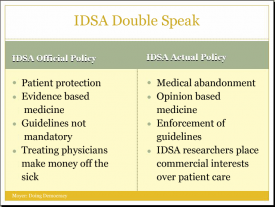
    Have you ever noticed how the IDSA says one thing, but really means and does another? For instance, how they say that their guidelines are there to protect patients when in fact they amount to medical abandonment? They are so stringent that sick patients are left completely without treatment options? Or how they say they are all about scientific evidence when in fact their guidelines are based primarily on expert opinion–the expert opinion of researchers with commercial ties to vaccine manufacturers, Lyme tests, and insurers? Or how they say their guidelines are not mandatory, but their members enforce their guidelines by testifying at unprofessional conduct hearings and the IDSA opposes physician protection legislation that would essentially make compliance with their guidelines truly voluntary? Or how they say they are worried about doctors who treat chronic Lyme making money off of sick patients, but they are not concerned about conflict of interest on their guidelines panels? This is called double speak. Saying one thing, doing another. George Orwell described this type of practice "newspeak"–words "deliberately constructed for political purposes: words, that is to say, which not only had in every case a political implication, but were intended to impose a desirable mental attitude upon the person using them." I'd say we could all use a little more plain talk.

  • Taming the beast: No MUS, No Fuss!

    Patients with Lyme disease know how important the definition of an illness can be. We know that the difference between chronic Lyme and Post Lyme Disease Syndrome is the difference between receiving treatment and being medically abandoned. So what’s with all the “new” language at the IDSA hearing about medically unexplained symptoms? MUS for short. No fewer than 3 IDSA speakers use this expression: Drs. Weinstein, Shapiro, and Wormser. It was like they synchronized talking points. First, let me tell you what MUS and PLDS have in common—no antibiotic treatment. Because—guess why? Because the term MUS applies to diseases of unknown etiology— diseases with no identified cause. But wait, you say. Doesn’t Lyme disease have a cause? You might assume that given that the bacteria has been identified, Lyme disease has a cause and isn’t really “unexplained”?

  • IDSA Lyme Hearing: Wormser– Talk About Exaggeration!

    Talk about exaggeration. No really–at the hearing. Dr. Carol Baker asked Dr. Wormser the $200 question: Why exaggerate if the truth will do? She was talking about the use in the guidelines of words like "vast majority" when the real percentage was 65%. And her question was why not let percentages speak for themselves? If the truth is 65%–why not simply say 65%. Is it just me, or does Wormser sound irritated at the question? His response after a drill down is that he would not use the expression "vast majority" to refer to anything less than say–90%. Excuse me? Did I hear that right? 90%. Really? Ok, let's break it down for him.

  • IDSA Lyme Hearing– Contested Recommendations

    Most of you know the hearing on July 30th before the IDSA hearing panel was about "contested recommendations" in the IDSA 2006 guidelines. These are recommendations and language in the IDSA guidelines that we contest or take issue with. They are important because they provide the road map for what the IDSA hearing panel must review. Contested recommendations must be evaluated by the panel. In order to remain in the guidelines, a supermajority (7 of the 9 panel members) must find that the contested recommendation is supported by the medical/scientific evidence presented at the hearing or otherwise submitted.

  • LYME POLICY WONK: CALDA survey results are in!

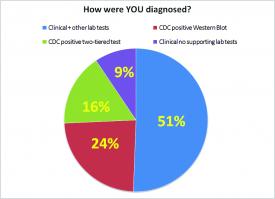
    Ask the Lyme community a question, or two or 30 and they answer! When we asked for input before the IDSA Lyme hearing, we had 3,600 completed surveys within 2 months—that’s astounding! I want to thank everyone who participated. The survey results provide very important information for the Lyme community and will be useful to describe the extent of the problem that patients have being timely diagnosed, treated, reimbursed, seriously ill and the devastating effect the guidelines have on patients health.

End of content

End of content