
Removing the Mask of Average Treatment Effects in Chronic Lyme Disease Research Using Big Data and Subgroup Analysis

Johnson, L., Shapiro, M., & Mankoff, J. (2018). Removing the Mask of Average Treatment Effects in Chronic Lyme Disease Research Using Big Data and Subgroup Analysis. Healthcare, 6(4), 124. https://doi.org/10.3390/healthcare6040124
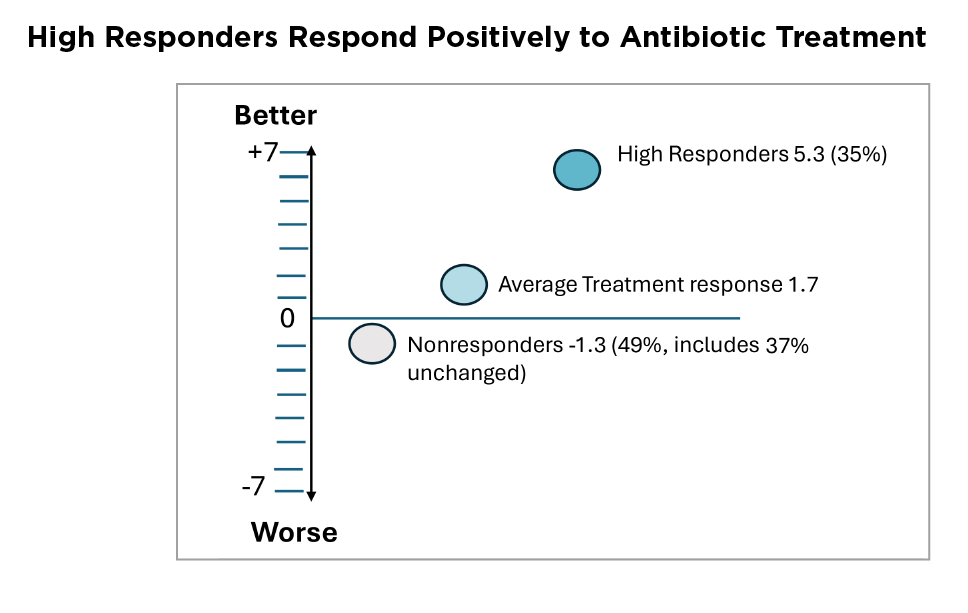
High Responders respond positively to antibiotic treatment. Subgroup analysis reveals meaningful outcomes that can be hidden by the average response.

This study takes a closer look at how people with Lyme disease respond to treatment—and it challenges the idea that “average results” tell the whole story about treatment effectiveness. Traditional research has focused on treatment averages, and has been used to deny further treatment for patients who remain ill. However, this approach ignores the fact that some patients improve significantly while others don’t improve at all.

By analyzing data from nearly 4,000 patients in the MyLymeData registry, researchers found a much more nuanced picture. At first glance, the average treatment effect seemed minimal. But a deeper look told a different story: 52% of patients reported improvement, and 35% were classified as High Responders. This shows how relying only on averages can be misleading and may result in patients being denied treatments that could improve their health.

The findings highlight the need for more personalized care. Every patient’s experience with Lyme disease is different, and treatment decisions should reflect that. By using real-world data and focusing on individual responses, this research supports a more patient-centered approach—one that gives people a better chance at meaningful recovery.

Background. Small and highly selective Lyme disease treatment trials have often relied on average treatment effects, even though patients seen in clinical practice differ considerably in disease history, severity, coinfections, and treatment response.

Methods. Researchers analyzed patient-reported outcomes from nearly 4,000 MyLymeData participants using the Global Rating of Change scale. Subgroup analysis was used to look beyond the overall average and identify patients who reported substantial improvement.

Results. The overall average suggested only modest improvement, but the distribution revealed meaningful treatment heterogeneity. Approximately 52% reported some improvement and 35% met the definition of High Responders.

Conclusion. Examining subgroups can reveal clinically important treatment effects that disappear when all patients are represented by a single average. Large patient registries can support more individualized and patient-centered research.

Study Purpose

The study demonstrates how average treatment effects can conceal meaningful differences between patients and explores whether real-world registry data can identify subgroups that respond particularly well to treatment.

Research Approach

Participants used a validated Global Rating of Change scale to report whether they became better, worse, or remained unchanged after antibiotic treatment. Researchers then examined the distribution of responses rather than relying only on the overall mean.

Key Results

The average response was modest, but subgroup analysis showed that a substantial portion of patients reported meaningful improvement. High Responders had an average response of 5.3 on the scale, while the overall average was 1.7 and the Nonresponder group averaged −1.3.

Implications

Treatment decisions and future research should account for variation among patients. Larger real-world datasets can help identify which characteristics, treatment approaches, and durations are associated with better outcomes.

The complete article includes the full references, supplementary materials, MyLymeData survey overview, treatment-response analysis, and discussion of pragmatic big-data trial design.

Study Details

Share This Study