LYME SCI: Tick-borne co-infections are the rule, not the exception

While Lyme disease is the fastest growing vector-borne disease in the United States, many other bacteria, parasites and viruses can also be transmitted by ticks.
These are generally referred to as “co-infections” of Lyme, since people often have them at the same time as Lyme disease. While US cases of Lyme disease are estimated to be over 300,000 per year, no one really knows the incidence of co-infections.
In a LymeDisease.org survey of over 3,000 patients with chronic Lyme disease, more than half reported laboratory-confirmed co-infections, with 30% having two or more. According to Dr. Richard Horowitz, “The existence of these co-infections explains why some people with Lyme remain chronically ill even after treatment.”
The most common co-infections reported with Lyme disease are Babesia (32%), Bartonella (28%) and rickettsial illnesses (26%). Rickettsial illnesses include ehrlichiosis (15%), Rocky Mountain spotted fever (6%), and anaplasmosis (5%).
[tweet_dis_img]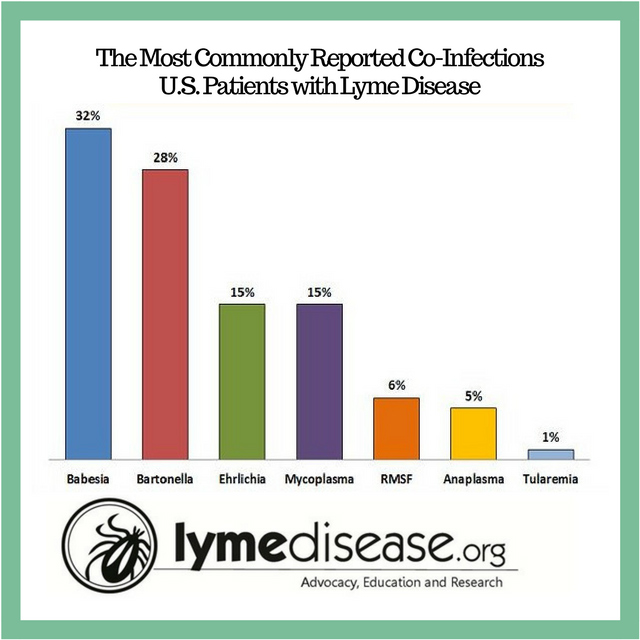 [/tweet_dis_img]
Ticks transmit 94% of vector-borne diseases
Most vector-borne diseases (VBDs) in the United States are transmitted by ticks. Of the nearly 50,000 cases of VBDs reported to the Centers for Disease Control (CDC) in 2014, 94% were tick-borne, with most of those being Lyme disease. Only 6% of VBDs were from mosquitoes. Yet, Lyme receives only a fraction of the research funding given to Zika and West Nile virus.
The recognition of tick-borne pathogens that are responsible for human illness is accelerating. Eleven new ones have been discovered since 1960, with over half of those found since 2000.
Several factors contributing to the increase of TBDs
- Improved diagnostics
- Climactic changes (warm wet weather)
- Reforestation and population increases of mice/deer
- Range expansion and population increases of ticks
- Lack of single, effective, widely accepted preventative strategy
Ixodes (hard-bodied) ticks
Of the 84 species of ticks found in the U.S., at least a dozen can infect humans. Ixodes (hard-bodied) ticks are the biggest culprits, known to transmit a large number of bacteria, parasites and viruses.
According to the CDC, seven out of the 18 reportable tick-borne diseases in the US are attributable to Ixodes ticks. The main vectors are Ixodes scapularis (blacklegged tick or deer tick) found east of the Rockies, and Ixodes pacificus (western blacklegged tick) found west of the Rockies.
Known pathogens transmitted by Ixodes ticks:
- Anaplasma phagocytophilum
- Borrelia burgdorferi
- Borrelia miyamotoi
- Borrelia mayonii
- Babesia microti
- Ehrlichia muris
- Powassan virus
Co-infections are the rule
To better understand how many microbes can be carried by ticks, scientists are going straight to the source—the tick. One such study took a deep dive into the pathogens carried by Ixodes ticks. While this research was conducted in France, I believe the conclusions are applicable to Ixodes ticks found throughout the world. Basically, ticks carry lots of bad stuff!
This study was the first to simultaneously test for 38 pathogens (bacteria, parasites and viruses) and four symbionts (other microorganisms that may affect the transmission of disease). Some symbionts may make it harder for the tick to transmit pathogens, while others may make it easier.
The results were astonishing! Every tick carried at least one symbiont, and 45% were co-infected with up to five different pathogens. When you include symbionts in the count, some ticks carried as many as eight microorganisms. The study’s findings are summarized in the chart below:
[tweet_dis_img]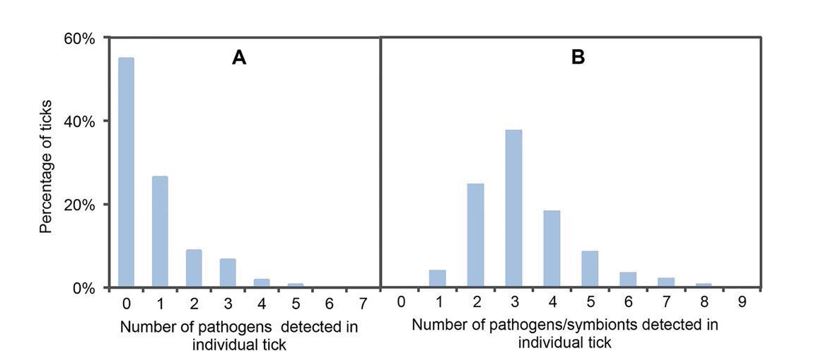 [/tweet_dis_img]
Ticks are toxic soup
In conclusion, if you are bitten by a tick, know that you may have been exposed to more than just Lyme disease, and that multiple infections increase the severity of illness.
This is the first in a four-part series on tick-borne rickettsial illnesses. Future blogs will discuss spotted fever rickettsiosis, ehrlichiosis, and anaplasmosis.
LymeSci is written by Lonnie Marcum, a Licensed Physical Therapist and mother of a daughter with Lyme. Follow her on Twitter: @LonnieRhea Email her at: lmarcum@lymedisease.org.
References:
Severity of chronic Lyme disease compared to other chronic conditions: a quality of life survey
Image: LYMEPOLICYWONK: Study Finds Coinfections in Lyme Disease Common
CDC | Public Health Grand Rounds: Emerging Tickborne Diseases
Co-infection of Ticks: The Rule Rather Than the Exception
Graph: Jean-Francois Cosson @jeffoscoulos (used with permission)

Dorothy Leland
Dorothy Kupcha Leland is President of LymeDisease.org. A writer and longtime advocate, she focuses on Lyme disease education, policy awareness, and patient support. She is co-author of Finding Resilience: A Teen’s Journey Through Lyme Disease and When Your Child Has Lyme Disease: A Parent’s Survival Guide.
Do You Have Lyme Disease?
Use our symptom checklist to better understand possible Lyme disease signs and next steps.
Newsletter Sign-up
Helpful Resources
Support LymeDisease.org
Your support helps us advocate for patients and fund critical Lyme disease research.